
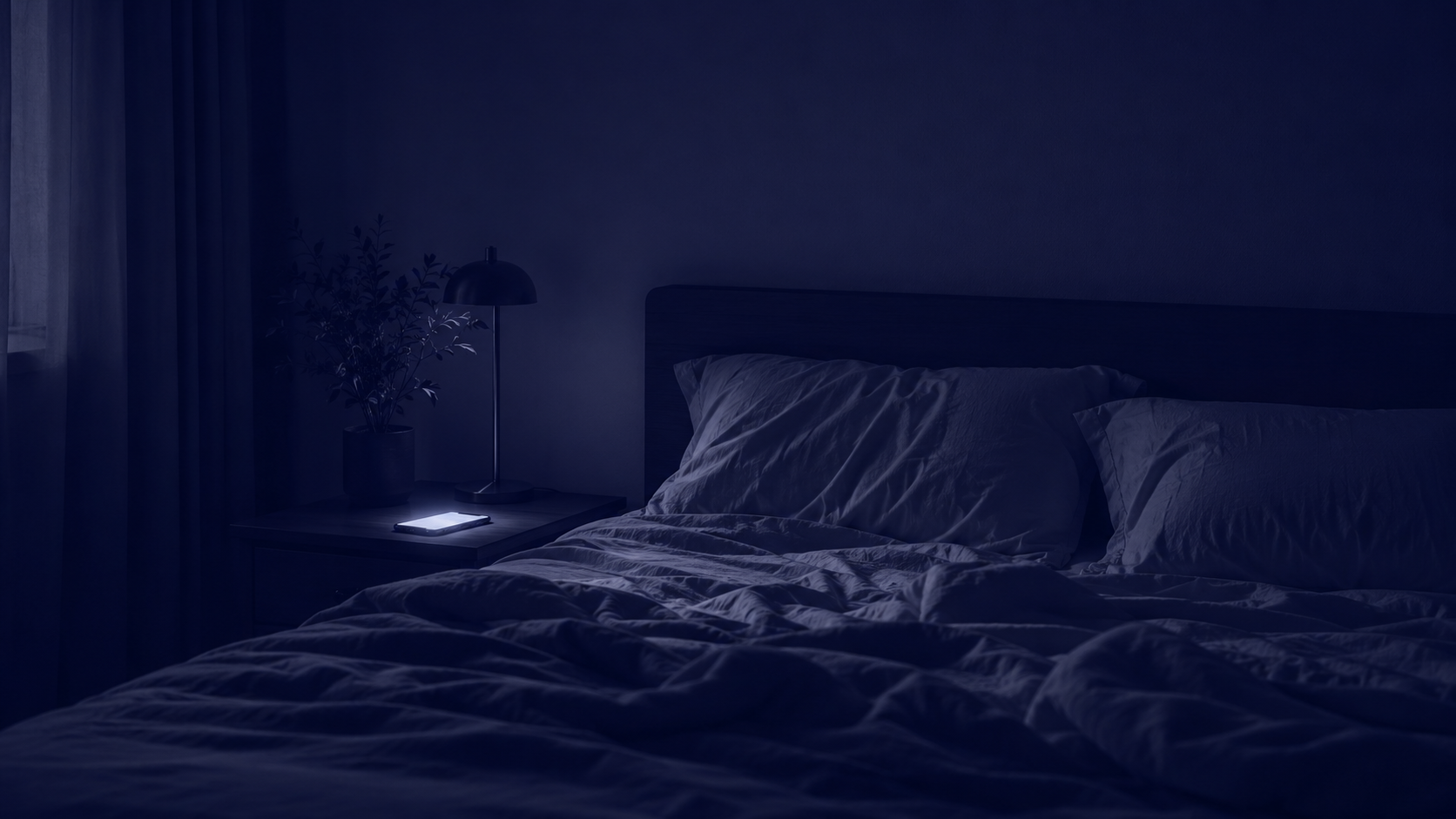
There’s a moment most of us know. It’s 12:40 a.m. You meant to be asleep an hour ago. Nothing is keeping you up — the show ended, the scrolling stopped being interesting twenty minutes back, and tomorrow is going to hurt. You stay up anyway.
That choice has a name. Researchers call it bedtime procrastination, and the version most people recognize has a sharper one: revenge bedtime procrastination. The fix isn’t more willpower. It starts with understanding what’s actually happening — because the cost is real, and it hides from you while it adds up.
It has a name — and that changes things
In 2014, a team of researchers led by Dr. Floor Kroese defined bedtime procrastination as failing to go to bed at your intended time when nothing external is stopping you. No newborn. No night shift. No emergency. Just you, awake, choosing the couch over the pillow.
That definition matters more than it sounds. It separates a behavior from a character flaw. The same group found this wasn’t really a knowledge problem — people who do it know they should sleep, and they know how. The gap is in following through, not in understanding.
The “revenge” layer came later, traced to a phrase that spread online around 2020 describing the act of staying up to reclaim personal time the day swallowed. The word resonated because it named the feeling underneath the behavior: these late hours don’t feel wasted. They feel earned.
The trade you’re actually making
Here’s where it stops being harmless. The hours feel free, but the exchange rate is steep — and the bill is delayed in a way that fools almost everyone.
A landmark study published in the journal Sleep tracked what happens when people sleep six hours a night instead of eight — not one rough night, a routine. After two weeks of six-hour nights, participants were as cognitively impaired as people who had gone two full nights without any sleep. Their reaction time, focus, and judgment had eroded to the level of someone who’d pulled back-to-back all-nighters.
The unsettling part isn’t that number. It’s the second finding: the people in that study thought they were fine. They reported feeling only slightly sleepy while their actual performance kept falling. The body adapts its sense of how tired it is long before it adapts its function. You feel leveled off. You’re still sinking.
So the weekend becomes the plan — catch up Saturday, reset Sunday, start fresh Monday. The research isn’t kind to that plan either. When scientists gave people a chance to sleep freely on weekends after a week of short sleep, they recovered only about an extra hour, and it still failed to undo the damage. Insulin sensitivity dropped. Weight crept up. The weekend felt restorative. The biology didn’t agree.
Two illusions, stacked: you don’t feel the impairment building, and you don’t get back what you think you do.
Why your brain keeps choosing this
If bedtime procrastination were laziness, it would hit the least disciplined people hardest. It does the opposite — and understanding why is the key to changing it.
The research points to self-regulation. Your capacity to override an impulse — to do the harder right thing — runs down over the course of a day like a battery. Every decision, every bit of restraint at work, every patient answer to a kid’s tenth question draws from the same reserve. By late evening, the reserve is low. Researchers found that people with less self-control reported more bedtime procrastination and shorter sleep, and later work showed it isn’t only a fixed trait: on the days you spend the most self-control, you’re the most likely to delay bedtime that very night.
That reframes the whole thing. The nights you most need rest — the days that drained you — are exactly the nights you’re least equipped to put yourself to bed. The behavior isn’t a discipline failure. It’s what self-discipline running out looks like.
It also explains who struggles most. People with the least control over their daytime hours tend to procrastinate bedtime more. When the day belongs to everyone else, the night feels like the only territory that’s yours. That’s the revenge. Students show the pattern heavily; so do night owls, whose internal clocks already push them later.
And then there’s the loop that closes the trap. Lying there frustrated about being awake, doing the math on how few hours are left, raises the exact arousal that keeps you awake. Worry about sleep degrades sleep. The guilt doesn’t motivate — it compounds.
The off-ramp — and the line worth watching
The encouraging news: the most effective fixes target the real mechanism, not the symptom. Telling someone to “just go to bed earlier” ignores that their problem was never information. What works is reducing the number of decisions you have to make when your reserve is already empty.
The strongest evidence is for if-then planning. Instead of a vague intention to sleep earlier, you decide in advance: when this specific thing happens, I do that specific action. When the episode ends, I plug in my phone in the kitchen. When it’s 10:30, the lights go warm. People who set plans like these procrastinated bedtime measurably less, because the choice was made earlier in the day, when self-control was still in the tank.
A consistent wind-down routine works on the same logic — it turns the approach to bed into a sequence you don’t have to negotiate each night. And for the autonomy piece underneath the revenge, the move is to give yourself real leisure earlier in the evening rather than clawing it back at midnight. If the day held even a small pocket that was genuinely yours, the 12:40 a.m. rebellion loses some of its fuel.
There’s also a line worth knowing, because not every sleepless night is procrastination. When trouble sleeping shows up at least three nights a week for three months or longer, that meets the clinical threshold for chronic insomnia — a medical issue, not a habit to redesign. If you’re on that side of the line, the most studied treatment isn’t a medication: cognitive behavioral therapy for insomnia (CBT-I) is the approach sleep specialists reach for first, and it’s well established. The point is simple: this is treatable.
When it’s worth talking to a sleep specialist
Most nights of revenge bedtime procrastination are a habit you can reshape on your own. But if the late nights have turned into most nights — if you’re crossing that three-night, three-month line, waking unrefreshed no matter how early you turned in, or your partner notices you snoring or stopping breathing — that’s worth an evaluation, not another lost weekend.
At Gwinnett Sleep, part of Gwinnett Pulmonary & Sleep in metro Atlanta, that evaluation often starts simply: a conversation, and when it’s warranted, an at-home sleep study you do in your own bed rather than a lab. The goal isn’t to medicalize a late night. It’s to tell the difference between a habit and a condition — and to treat the condition when there is one.
The bigger picture
Put the pieces together and a clearer story emerges than “stop staying up late.” Bedtime procrastination is what happens when a depleted day meets a brain that’s out of restraint and starved for autonomy. The cost accumulates invisibly, because you’re built to stop feeling it before you stop being affected by it. And the recovery you’re counting on returns less than you assume.
That’s not a reason for guilt — guilt is part of the loop. It’s a reason to move the decision earlier in the day, to protect a little time that’s actually yours before the night has to be, and to know the line where a habit becomes something worth a closer look.
The hour you’re reclaiming at midnight was supposed to be tomorrow’s energy. You can have the time back without borrowing it from yourself. And if the nights keep getting away from you no matter what you try, that’s worth a conversation with a sleep specialist — not another lost weekend. Schedule a sleep consultation with Gwinnett Sleep