
If you’ve recently been told that you have a lung nodule or an abnormal finding on a CT scan, you may feel worried and unsure about what comes next. At Gwinnett Pulmonary & Sleep, we offer advanced diagnostic tools to help provide clear answers as safely and comfortably as possible. One of the most innovative options available today is robotic navigational bronchoscopy.
This minimally invasive procedure allows our pulmonologists to reach small or hard-to-access areas of the lung with exceptional precision. Using advanced robotic technology and detailed imaging guidance, we can biopsy lung nodules and evaluate abnormalities with greater accuracy and less risk than many traditional methods.
Our goal is simple: help you breathe easier and get the answers you need with confidence.
Book an Appointment | Contact Us
What Is Robotic Navigational Bronchoscopy?
Robotic navigational bronchoscopy is a highly advanced, minimally invasive procedure used to examine the lungs and obtain tissue samples (biopsies). It combines traditional bronchoscopy techniques with robotic precision and 3D imaging technology.
During a bronchoscopy, a thin, flexible tube called a bronchoscope is gently guided through your mouth or nose into your airways. With robotic-assisted bronchoscopy, the process is enhanced by a robotic platform that provides greater stability, control, and access to deep lung areas.
Why Is Robotic Navigation Bronchoscopy Performed?
Your provider may recommend robotic navigation bronchoscopy if imaging tests, such as a CT scan, reveal:
- A lung nodule
- A suspicious lung mass
- Abnormal lung tissue
- Areas of concern that require further evaluation
Diagnosing Lung Nodules
Lung nodules are small spots in the lungs that are often found during routine imaging. Many nodules are harmless, but some may require further testing to rule out infection, inflammation, or lung cancer.
Navigational bronchoscopy allows us to biopsy these nodules without the need for more invasive surgery. Early and accurate diagnosis is critical, and robotic technology enables precise tissue sampling.
Evaluating for Lung Cancer
If there is concern for lung cancer, early detection significantly improves treatment options and outcomes. Robotic bronchoscopy enables us to reach small or deep nodules that may not be accessible with traditional bronchoscopy techniques.
Investigating Unexplained Lung Symptoms
This procedure may also be used when patients experience:
- Persistent coughing
- Unexplained shortness of breath
- Abnormal imaging findings
- Recurrent infections
Book an Appointment | Contact Us
Benefits of Robotic-Assisted Bronchoscopy
Advanced technology means meaningful benefits for patients.
Greater Precision
The robotic platform allows for more stable navigation within the airways. With systems such as ION robotic bronchoscopy, your physician can follow a detailed 3D pathway directly to the targeted area.
Minimally Invasive
Unlike surgical lung biopsies, robotic navigational bronchoscopy does not require large incisions. The procedure is performed through your natural airways.
Reduced Risk
Compared with some traditional biopsy methods, robotic-assisted bronchoscopy may reduce the risk of complications, such as lung collapse (pneumothorax).
Faster Recovery
Since this is an outpatient procedure, patients go home the same day. Recovery time is typically shorter than with surgical procedures.
Earlier Diagnosis
Because we can reach smaller and more distant lung nodules, this technology supports earlier detection and faster treatment planning when needed.
What to Expect Before the Procedure
If your doctor recommends robotic navigation bronchoscopy, our team will guide you every step of the way.
Pre-Procedure Evaluation
You may undergo:
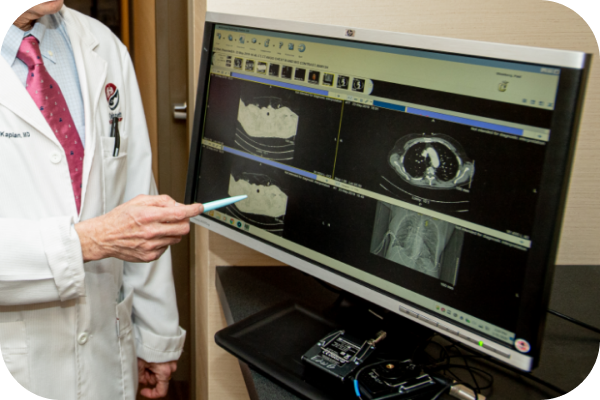
- A detailed CT scan to map your lungs
- A review of your medications
- Lab work i,f necessary
Your provider will explain:
- When to stop eating or drinking
- Whether to pause certain medications
- What to expect on the day of the procedure
We encourage you to ask questions. Our team is here to make sure you feel informed and comfortable.
What Happens During Robotic Bronchoscopy?
The procedure is typically performed in a hospital or specialized procedure center.
Sedation and Comfort
Most patients receive sedation or anesthesia to ensure comfort. You will not feel pain during the procedure.
Advanced Navigation
Using your CT scan images, the physician creates a virtual pathway to the lung nodule. With ION robotic navigation bronchoscopy, the robotic system guides the bronchoscope along this path with remarkable accuracy.
The robotic platform does not replace your doctor; it enhances their ability to navigate carefully within your lungs.
Biopsy Collection
Once the bronchoscope reaches the targeted area, small instruments are passed through it to collect tissue samples. These samples are sent to a laboratory for analysis.
Procedure Length
The procedure usually lasts about 60 to 90 minutes, depending on complexity.
What to Expect After the Procedure
After robotic navigational bronchoscopy, you will be monitored as the sedation wears off. Most patients go home the same day.
You may experience:
- Mild sore throat
- Light coughing
- Fatigue
These symptoms typically resolve within a day or two.
Your care team will provide clear discharge instructions and let you know when to expect results. In many cases, biopsy results are available within several days.
If you experience:
- Severe chest pain
- Shortness of breath
- Fever
- Persistent bleeding
You should contact your provider immediately.
Is Robotic Navigation Bronchoscopy Safe?
Yes. Robotic-assisted bronchoscopy is considered safe and effective when performed by trained pulmonologists. Like any medical procedure, there are risks, but complications are uncommon.
Potential risks may include:
- Bleeding
- Infection
- Lung collapse (rare)
At Gwinnett Pulmonary & Sleep, patient safety is always our priority. Our experienced team carefully evaluates each patient to ensure this procedure is appropriate.
Why Choose Gwinnett Pulmonary & Sleep?
When it comes to lung health, experience and technology matter.
Board-Certified Pulmonologists
Our physicians are highly trained in advanced diagnostic procedures, including robotic bronchoscopy and navigational techniques.
Advanced Technology
We use state-of-the-art systems, such as ION robotic bronchoscopy, to provide precise, minimally invasive lung evaluation.
Patient-Centered Care
We understand that waiting for answers about your lung health can be stressful. Our team is committed to:
- Clear communication
- Compassionate care
- Thorough follow-up
- Personalized treatment planning
We treat every patient with the attention and respect they deserve.
Gwinnett Pulmonary & Sleep proudly serves patients throughout Gwinnett County and the areas north of Atlanta. With multiple convenient locations, our team is committed to providing advanced pulmonary care close to home. We are dedicated to supporting the health of our local community with accessible, compassionate, and high-quality lung care.
Book an Appointment Today
If you’ve been referred for evaluation of a lung nodule or abnormal imaging, robotic navigational bronchoscopy may provide the clarity you need, safely and efficiently.
At Gwinnett Pulmonary & Sleep, we guide you through every step of the process with advanced technology and compassionate care.
Call our office today to schedule an appointment.
Or request a consultation through our website to learn whether robotic bronchoscopy is right for you.
Book an Appointment | Contact Us
Frequently Asked Questions
Does robotic bronchoscopy hurt?
No. You will receive sedation or anesthesia, so you should not feel pain during the procedure.
How long is the recovery time?
Most patients return home the same day and resume normal activities within 24–48 hours.
How accurate is robotic navigational bronchoscopy?
Robotic systems provide improved reach and stability, helping increase the likelihood of obtaining accurate biopsy samples, especially in small or difficult-to-access nodules.
When will I receive results?
Biopsy results are typically available within several days. Your provider will review the findings with you and discuss next steps.
Is this better than a surgical biopsy?
In many cases, robotic navigation bronchoscopy allows us to avoid more invasive surgery. However, your provider will determine the best option based on your individual case.